
Digital AOX Case Challenges: A Laboratory Perspective
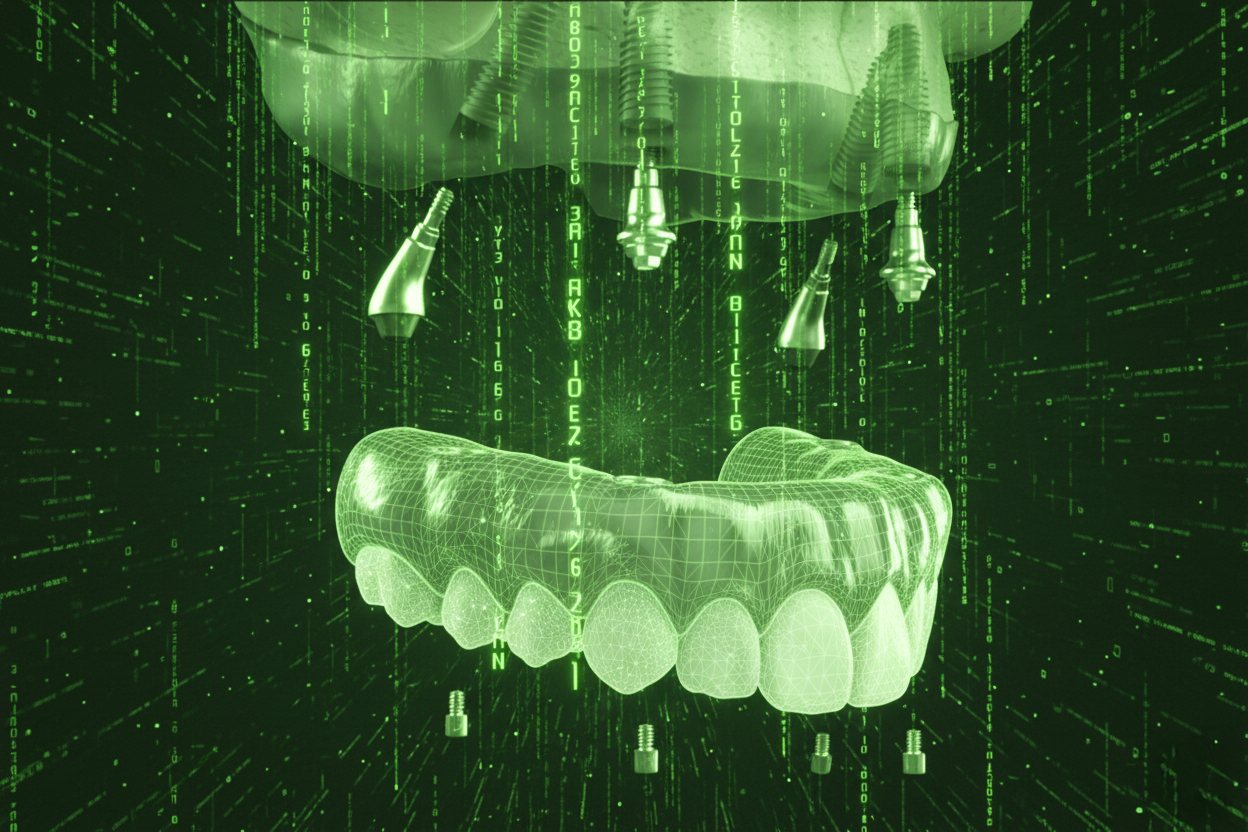
After more than 25 years working directly with All-On-X (AOX) cases and supporting thousands of full-arch rehabilitations across the country, my laboratory has seen the digital transformation of implant dentistry unfold in real time. The evolution has been remarkable, but it has also revealed recurring challenges that continue to affect consistency, accuracy, and patient satisfaction.
From a laboratory perspective, most of these challenges can be traced to four critical phases of the AOX workflow:
Pre-Surgical Data Acquisition
Surgical Protocol and Intraoperative Capture
Temporary Prosthesis Delivery
Final Restorative Phase (Post-Integration)
Addressing weaknesses in these areas is the key to achieving predictable, passive, and biologically safe outcomes.
1. Pre-Surgical Data Acquisition, The Foundation Most Overlooked
The pre-surgical phase is where long-term success is built or lost. Many patients arrive with a collapsed VDO, altered occlusion, or long-standing edentulism that must be reconstructed before surgery, yet this step is often skipped or approximated.
From a lab perspective, the issue is almost always incomplete or poor-quality data. We frequently receive segmented intraoral scans missing critical soft-tissue areas such as the palate, vestibule, and hamular notches. Without these, it is impossible to digitally rebuild the patient with accuracy.
Another growing concern is the use of old, inexpensive or poorly calibrated intraoral scanners that produce distorted data, or the practice of over-scanning, which can create inconsistencies in the digital model. The result is unnecessary troubleshooting and compromised precision before the case even begins.
And perhaps most frustrating of all is the absence of facial data.
It is astonishing that, in 2025, so many high-value AOX cases are still being planned without a 3D facial scan, or at the very least, a set of calibrated photographs showing repose, natural smile, and exaggerated smile. These cases are among the most expensive and complex treatments in dentistry. Failing to include facial data is simply unacceptable. Whether due to a lack of understanding of its value or indifference to the process, skipping facial scans is a serious mistake that undermines esthetic planning and patient outcomes.
The technology is available, affordable, and incredibly effective. Every clinician performing AOX should have access to a facial scanner and know how to use it properly. We are well into the digital era, and this step is no longer optional.
An ideal pre-surgical dataset should include:
Full upper and lower scans captured at the correct VDO (or traditional impressions)
A properly mounted and verified bite registration at the correct VDO
A facial scan or calibrated photos for smile design and midline alignment at the correct VDO
When necessary, a temporary restoration to re-establish the patient’s 3D bite at the correct VDO
In analog dentistry, small inaccuracies can be adjusted chairside. In digital workflows, what the lab receives is the final truth, and there is no margin for error.
2. Surgical Protocol and Intraoperative Acquisition, Consistency Is Everything
Even the most skilled surgeons can run into complications if their digital protocol is not rehearsed and standardized. AOX digital workflows demand precision, preparation, and coordination between every member of the surgical team.
One of the most common pitfalls is inaccurate or missing reference-marker scans. This scan must always be taken before extractions to anchor the digital workflow. When skipped, misplaced, or captured incorrectly, the entire process becomes unreliable.
Frequent breakdowns we observe include:
Reference markers not fully seated or obscured in the scan
Scans performed after extractions, making them unusable
Scanners unavailable, uncalibrated, or operated by untrained staff
Poor-quality scans taken due to lack of training for this particular technique
Digital AOX workflows demand the same precision and repetition as suturing or flap design. Every team member, not just the surgeon, must understand the sequence and execute it flawlessly. Once the process is second nature, predictability follows.
3. Temporary Prosthesis Delivery, Preparation Prevents Problems
Delivering the temporary prosthesis is often seen as a simple placement step, but in reality, it is one of the most technique-sensitive parts of the AOX process. Proper seating, screw tightening, and torque management determine whether the restoration will remain passive or create strain on the implants.
Every restorative team should master:
Correct removal of protective caps
Proper seating sequence and alignment pressure
Identification and use of the correct calibrated driver
Following a consistent screw-tightening pattern
Applying the proper torque values
Too often, restorative teams are unprepared, and the lab is called in to assist. While we are always glad to help, lack of preparation introduces unnecessary risk.
That is why we developed FI3LD’s Online Education Portal, a 24/7 learning platform with step-by-step videos, detailed manuals, and troubleshooting guides. It was created to eliminate the learning curve, but like all tools, it only works if it is actually used.
5. Final Restorative Phase, Precision Beyond Integration
Once osseointegration is complete, the final prosthesis should represent the culmination of all prior steps, yet this is also where small oversights can cause major issues.
The most common is occlusal shift. When posterior teeth are added to the final PMMA design, the bite often changes slightly. Without dynamic bite-tracking technology such as Modjaw, this shift is expected, but it must be identified and corrected chairside, which is easy to do.
We also frequently see inaccurate final bite scans. Slight patient movement or unverified occlusal registration can distort the digital bite. The most common causes are:
Delegating scanning to an untrained assistant
Skipping on-screen verification
Lack of a standard bite verification protocol
When these errors occur, the prosthesis will not seat passively, leading to delays and adjustments that could have been avoided through training and communication.
The Core Issue: Preparation
Every successful digital AOX case has one common factor, preparation.
After decades of collaboration with clinicians on thousands of AOX restorations, one truth has remained constant, teams that invest the time to learn and rehearse the protocol achieve outstanding results. Their patients experience smooth, predictable treatment, and the restorative process becomes a source of confidence rather than stress.
Conversely, when preparation is lacking, complications multiply. Digital dentistry rewards discipline and teamwork, not improvisation. The technology is extraordinary, but only when supported by well-trained, well-coordinated people.
Global Market Outlook
Full-Arch Prosthetics Market: $1.42 billion (2022) → $2.14 billion (2030), CAGR 6.1%
Dental Implants and Prosthetics Market: $12.6 billion (2025) → $18.8 billion (2030), CAGR 8.4%
Key Growth Drivers:
Aging population and increased edentulism
Advances in photogrammetry and CAD/CAM workflows
Growing patient demand for implant-supported restorations
Final Thought
Digital AOX dentistry represents the highest synthesis of art, science, and technology. Yet, its success depends entirely on preparation, communication, and teamwork.
After more than 25 years of hands-on AOX experience, I can say with confidence that the difference between frustration and success rarely lies in the technology, it lies in the people who use it. When every member of the team, from surgeon to technician, understands the why behind each step, outcomes become predictable, workflows flow naturally, and patients experience true satisfaction.
Unfortunately, today’s AOX landscape is fragmented. There are countless scanners, scan bodies, and workflows, each claiming precision, yet few independently verified. Too many variables, too little validation, and too many “experts” chasing commercial gain instead of scientific truth. The result is inconsistency, confusion, and unnecessary risk.
Our profession urgently needs leadership and standardization. The future of AOX cannot rely on scattered vendors or unverified claims. It requires a unified group with the skill, credibility, and vision to establish a foundation others can build upon.
That is the level of precision and collaboration our industry must now embrace, one case, one patient, and one team at a time.
About the Author
Frank-Charles Pope III is an entrepreneur, visionary leader, and master craftsman in dental technology, with over four decades of expertise. Trained in Europe, Japan, and the U.S., he refined his skills under world-renowned ceramic masters before becoming Vice President of one of the largest laboratories in the world, where he helped scale operations dramatically. He is the founder and owner of Allure Dental Studio, FI3LD Dental Solutions, and Conmetior, among other companies, pioneering advancements in full-arch digital workflows, facial scanning, and augmented reality in dentistry. A prolific innovator and sought-after speaker, Frank-Charles continues to push the boundaries of digital dentistry and patient care.