
What Happens After You Tighten a Screw
Why tightening is not a single moment in time.
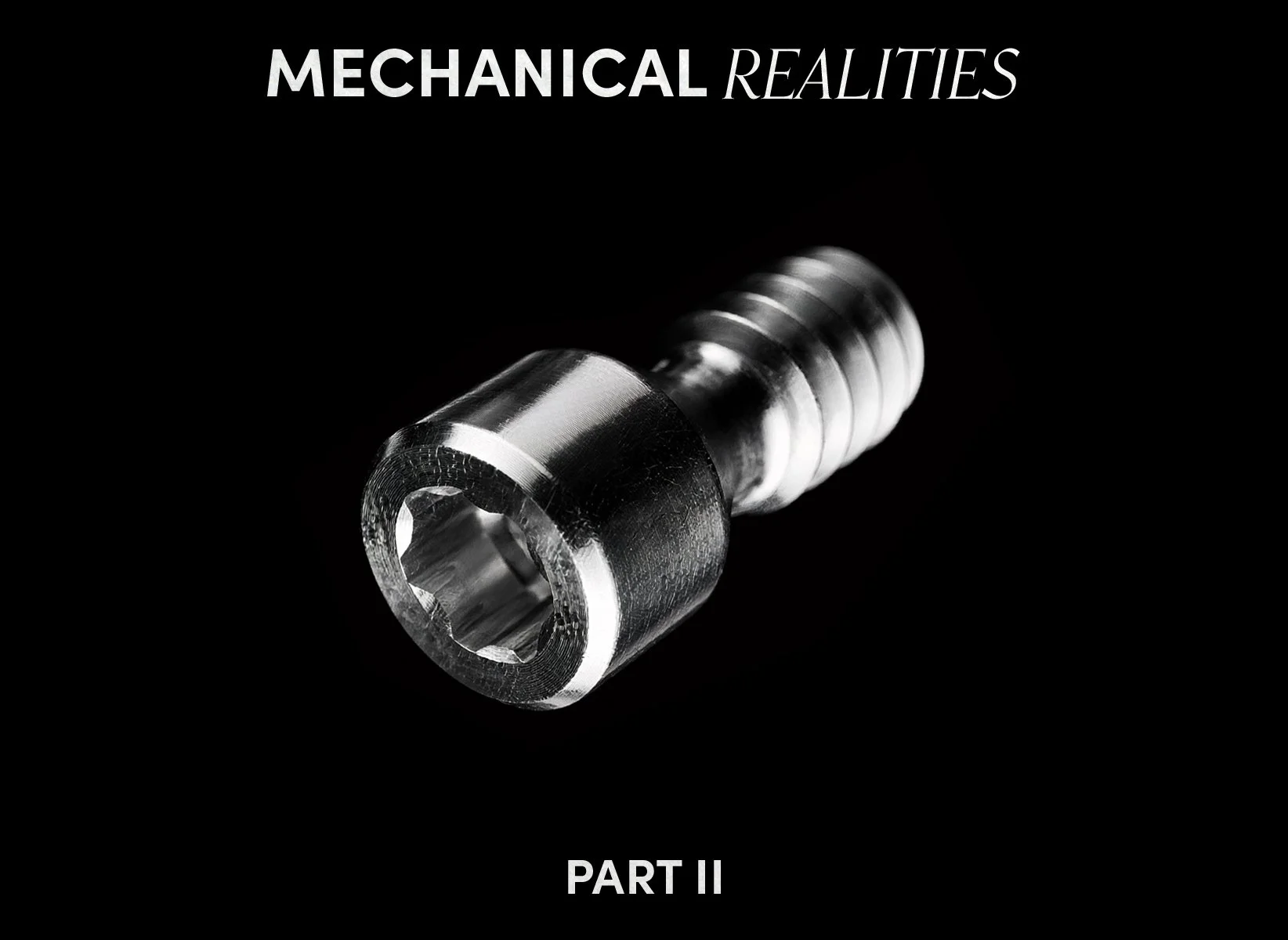
Tightening a screw feels decisive. A value is reached. A click is heard. The moment appears complete. Mechanically, it is not. What happens after tightening is just as important as the act itself.
Tightening Creates Preload, Not Stability
When a screw is tightened, it stretches slightly. That elastic stretch creates preload, the clamping force that holds components together. This preload is what provides stability, not the torque value itself. Torque is simply the method used to create that stretch.
The Settling Effect Begins Immediately
Once preload is established, the interface begins to change.
At the microscopic level:
Thread contact points flatten
Surface irregularities compress
Coatings conform to mating surfaces
This process is known as embedment relaxation, and it begins the moment tightening stops. As surfaces settle, preload decreases, even though the screw has not moved.
Why the First 24 Hours Matter
Studies from mechanical and orthopedic engineering consistently show that the greatest preload loss occurs early, often within the first day.
This loss is not caused by:
Loosening
User error
Material failure
It is a natural result of surfaces finding equilibrium under load. The screw is not backing out. The joint is stabilizing.
Tightening Speed Plays a Role
How a screw is tightened also influences what happens afterward.
When tightening occurs:
Too quickly, materials may not fully accommodate stress
Too slowly, time-dependent deformation (creep) can begin during tightening itself
Both scenarios affect how preload behaves after the fact. This is one reason why two identical tightening events can lead to different long-term outcomes.
Why Retightening Exists
Retightening is not redundancy. It is a response to mechanical reality.
By reintroducing torque after initial settling:
Lost preload can be partially recovered
Interface contact becomes more uniform
Long-term stability improves
This is not about adding force. It is about restoring what naturally diminished.
What This Means Clinically
Understanding post-tightening behavior explains several common observations:
A screw that feels different on re-engagement
A joint that feels more stable after a second tightening
A system that performs better when settling is acknowledged rather than ignored
Torque values set limits. Time changes conditions.
The Takeaway
Tightening is not a single event. It is the beginning of a mechanical process. Preload evolves. Interfaces settle. Stability develops over time, not instantly. Recognizing this turns tightening from a moment into a system.