
Why Screws Are Never “Identical”
What manufacturing reality means at the chair.
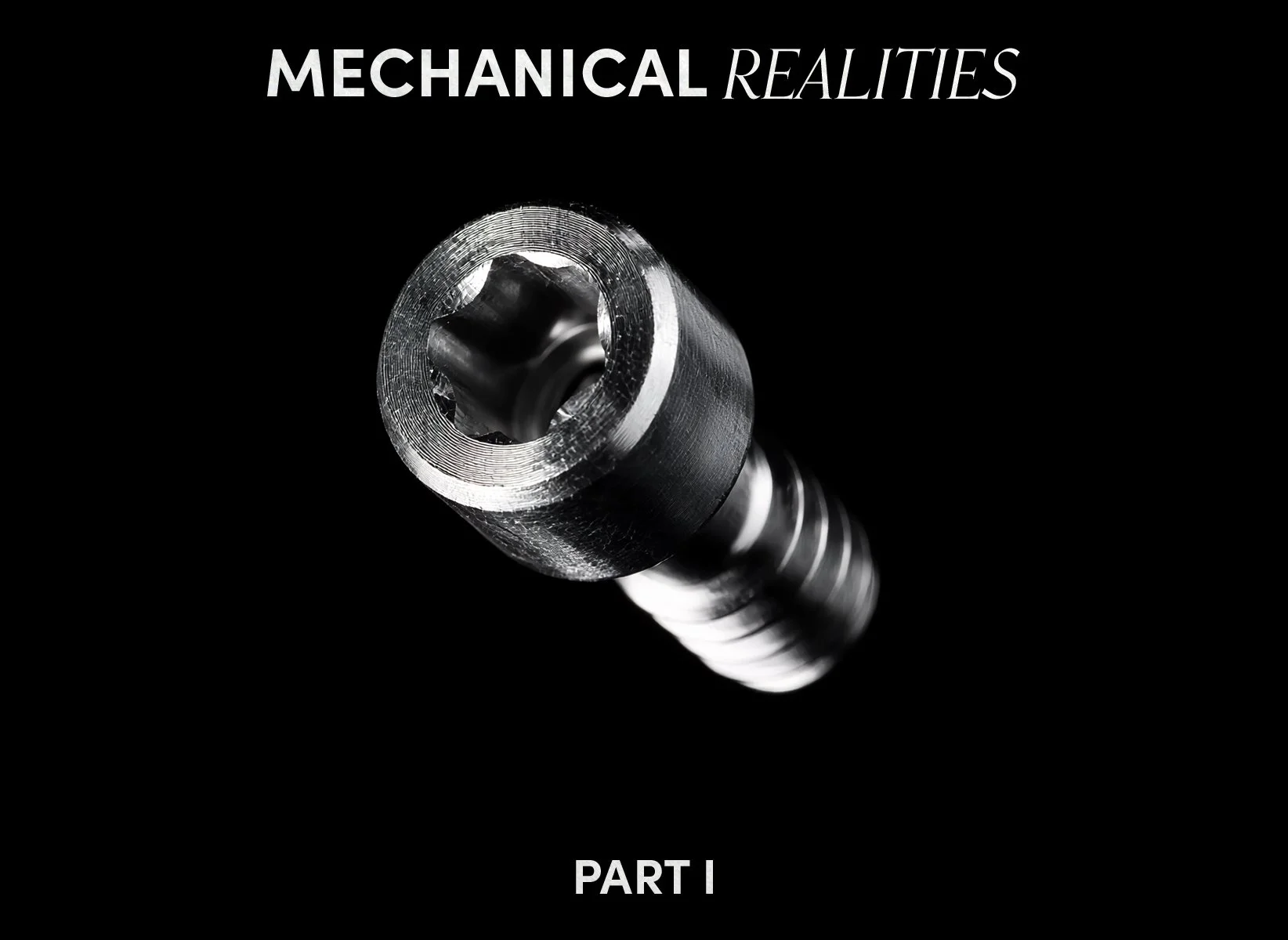
In dentistry, screws are often treated as interchangeable. Same brand. Same reference number. Same torque value. Mechanically, that assumption is incorrect. Even when screws come from the same manufacturer and the same production run, they are never truly identical in how they behave once tightened.
Manufacturing Tolerance Is Not a Defect
Every manufactured component is produced within an allowable tolerance range. This is not a flaw; it is how precision manufacturing works.
Microscopic differences exist in:
Thread geometry
Surface roughness
Head-to-driver interface
Coating thickness
These variations are measured in microns, invisible to the eye, and fully compliant with standards. Yet mechanically, they matter. Because screws do not fail at the macro level. They succeed, or fail, at the interface.
Surface Roughness Changes Friction
The interaction between a screw and an implant is dominated by friction.
Two screws with slightly different surface finishes will:
Consume different amounts of applied torque
Generate different preloads at the same torque value
Feel different during tightening
This is why one screw may feel smooth and progressive, while another feels resistant or abrupt despite being “the same.” The number hasn’t changed. The interface has.
The First Tightening Changes the Screw
A screw is not mechanically neutral after its first use.
During initial tightening:
High points on threads flatten
Surface asperities compress
The head interface experiences localized stress
This process permanently alters the contact surfaces.
As a result, a screw that has been tightened once will not behave the same way if tightened again, even if nothing appears damaged.
This is not wear in the traditional sense. It is mechanical conditioning.
Why the Screw Head Often Shows Wear First
In most dental systems, the highest stress concentration occurs at the screw head, not the threads.
This is where:
Torque is introduced
Driver engagement occurs
Rotational force transitions into axial load
Minor deformation at the head can occur long before thread damage is visible. When clinicians notice early rounding or loss of crisp engagement, they are seeing stress evidence, not manufacturing failure.
What This Means Clinically
Understanding that screws are not identical reframes expectations.
It explains why:
Two screws tightened to the same value can behave differently
“Feel” varies even under controlled conditions
Consistency depends on systems, not assumptions
Torque values define limits. They do not eliminate variability.
The Takeaway
Screws are precision components, but precision does not mean uniform behavior.
Mechanical reality lives in:
Microns
Friction
Surface interaction
Recognizing this doesn’t complicate dentistry. It makes outcomes easier to understand, and easier to control.