
Zirconia Rarely “Just Breaks”
Why failure is usually designed in, long before it appears.
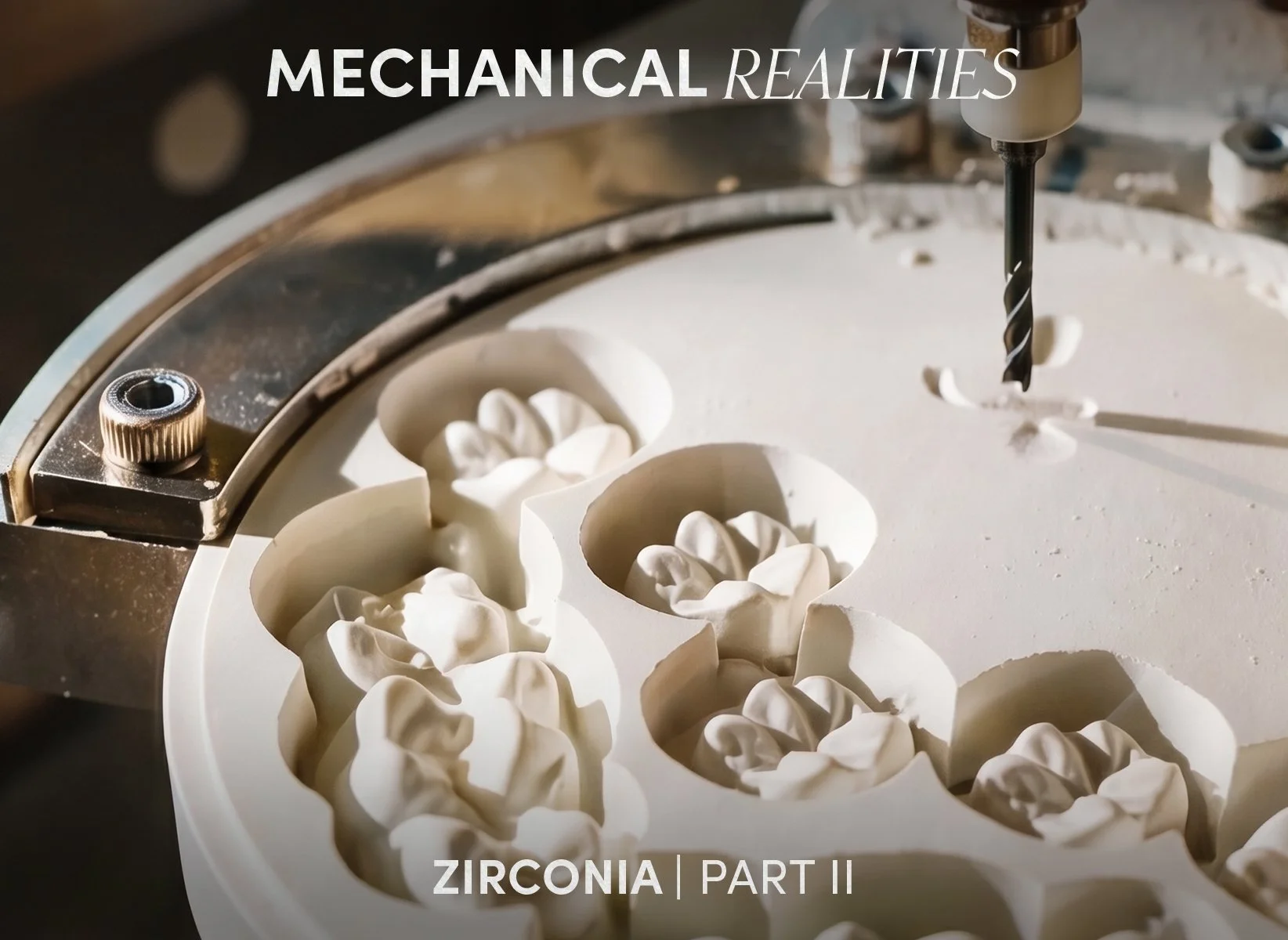
Zirconia fractures are often described clinically as sudden events. Mechanically, they are the final step of a long process. Ceramics fail through flaw-driven crack propagation. Microscopic defects introduced during manufacturing, adjustment, or surface modification act as stress concentrators. Under repeated loading, these flaws grow incrementally until the remaining cross-section can no longer sustain the applied force. This process is called subcritical crack growth. It is slow, silent, and cumulative.
By the time a zirconia restoration fractures, the failure mechanism has usually been active for weeks, months, or years. The fracture itself is not the failure. It is the moment the system finally exceeded its remaining tolerance.
In AOX restorations, this progression is accelerated by cyclic loading, cantilevers, non-axial forces, and high functional demands. Each chewing cycle advances crack growth slightly. The restoration may appear stable until the moment it no longer is. Surface damage matters more than most clinicians realize.
Grinding, reshaping, or adjusting zirconia introduces surface flaws that reduce fatigue life. Even when polished afterward, the original damage may not be fully eliminated. The restoration continues functioning, but with a diminished margin of safety. This explains why zirconia failures often feel unpredictable. Nothing obvious changed. No single event stands out. From an engineering perspective, the outcome was determined much earlier.
Zirconia does not fail randomly. It fails where defects, tensile stress, and time intersect. Understanding this reframes responsibility. The issue is not whether zirconia is strong enough, but whether surface integrity and stress distribution were preserved throughout fabrication, delivery, and adjustment. Once that margin is consumed, failure becomes a matter of when, not if.