
 Image 1 of 1
<3 sec
Measurement Time
IST 1-99
Trusted Stability Scale
$0
No Peg = No Cost
Auto-Stop
Implant-Safe Tapping
All Systems
Universal Compatibility
See It In Action
Watch how OsseoSense Pro™ works
A quick demonstration of measuring implant stability chairside — from probe placement to IST reading in seconds.
How It Works · The IST Scale
A number you can trust, in under 3 seconds
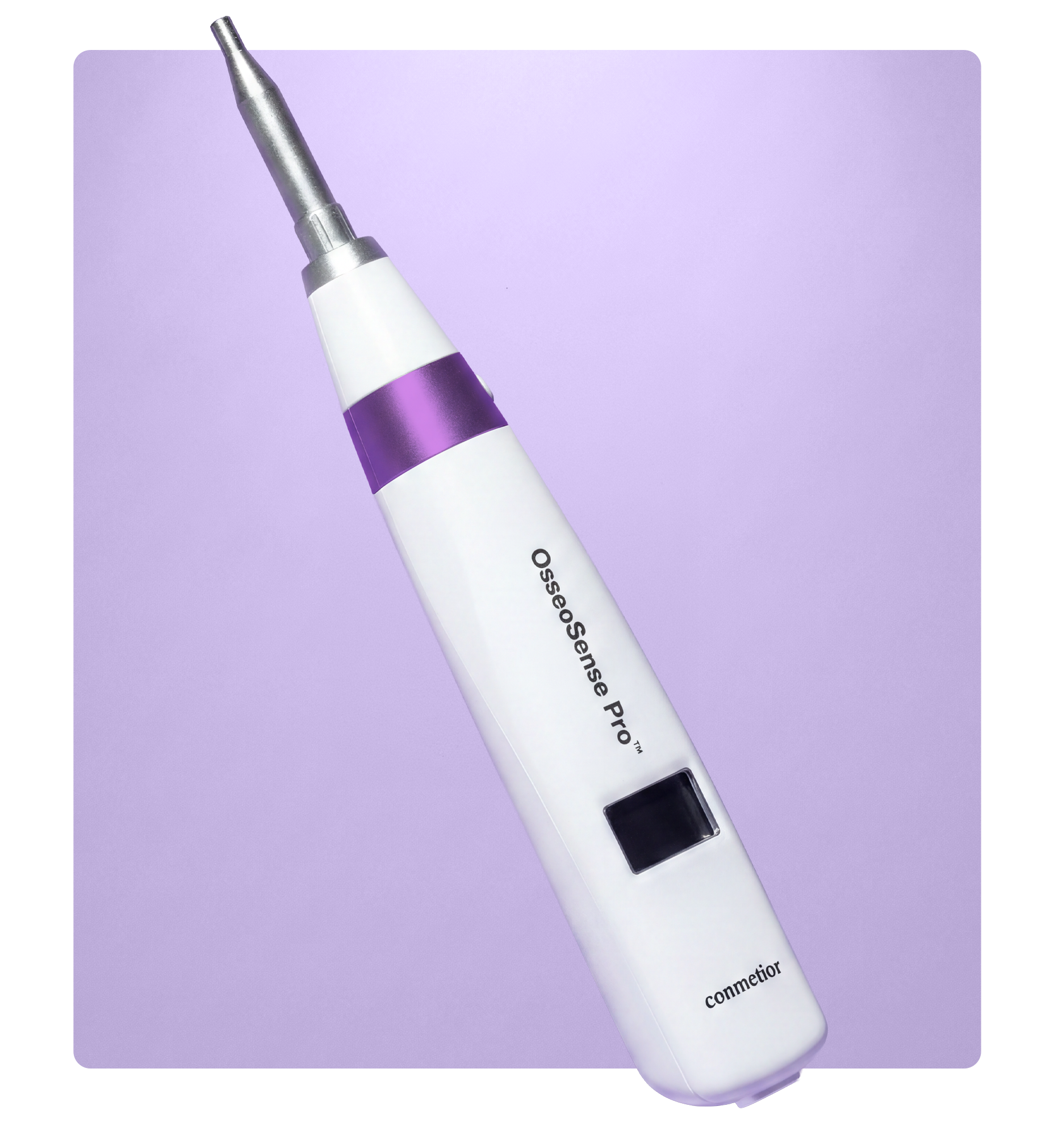
OsseoSense Pro™ taps the restoration with a gentle, controlled motion and analyzes the response, returning an Implant Stability Test (IST) value from 1 to 99 in less than three seconds. Higher means better integration — and a clearer path to loading.

*Readings can vary with healing-abutment height; measure from multiple angles. Clinical thresholds are guidance — always apply professional judgment and manufacturer protocols.
Reading in under 3 seconds
A gentle physical tapping technique delivers a precise, repeatable IST reading in less than three seconds — fast enough for routine chairside use.
No single-use pegs
Eliminates costly, single-use titanium pegs that vary by implant type — simplifying the process and cutting per-case expense.
Works on crowns & abutments
Assess directly on healing abutments, abutments, impression copings, scan bodies, and crowns — no need to remove the restoration.
Built-in safety auto-stop
Gentle, low-force taps with an automatic limiter: tapping stops after just two taps if integration is unstable, and continues up to six only when the implant is stable.
Confident loading times
Reliably assess osseointegration so you remove uncertainty when deciding safe loading times — and lower the risk of failure.
Universal compatibility
Compatible with all major implant systems — an affordable, versatile, user-friendly solution for placement and restoration alike.
Why Clinicians Switch
Accuracy, safety, and economy in one wand
Every advantage of OsseoSense Pro™ removes a cost, a risk, or a question from your implant workflow.
Everything in the Box
One reusable system, every restoration type
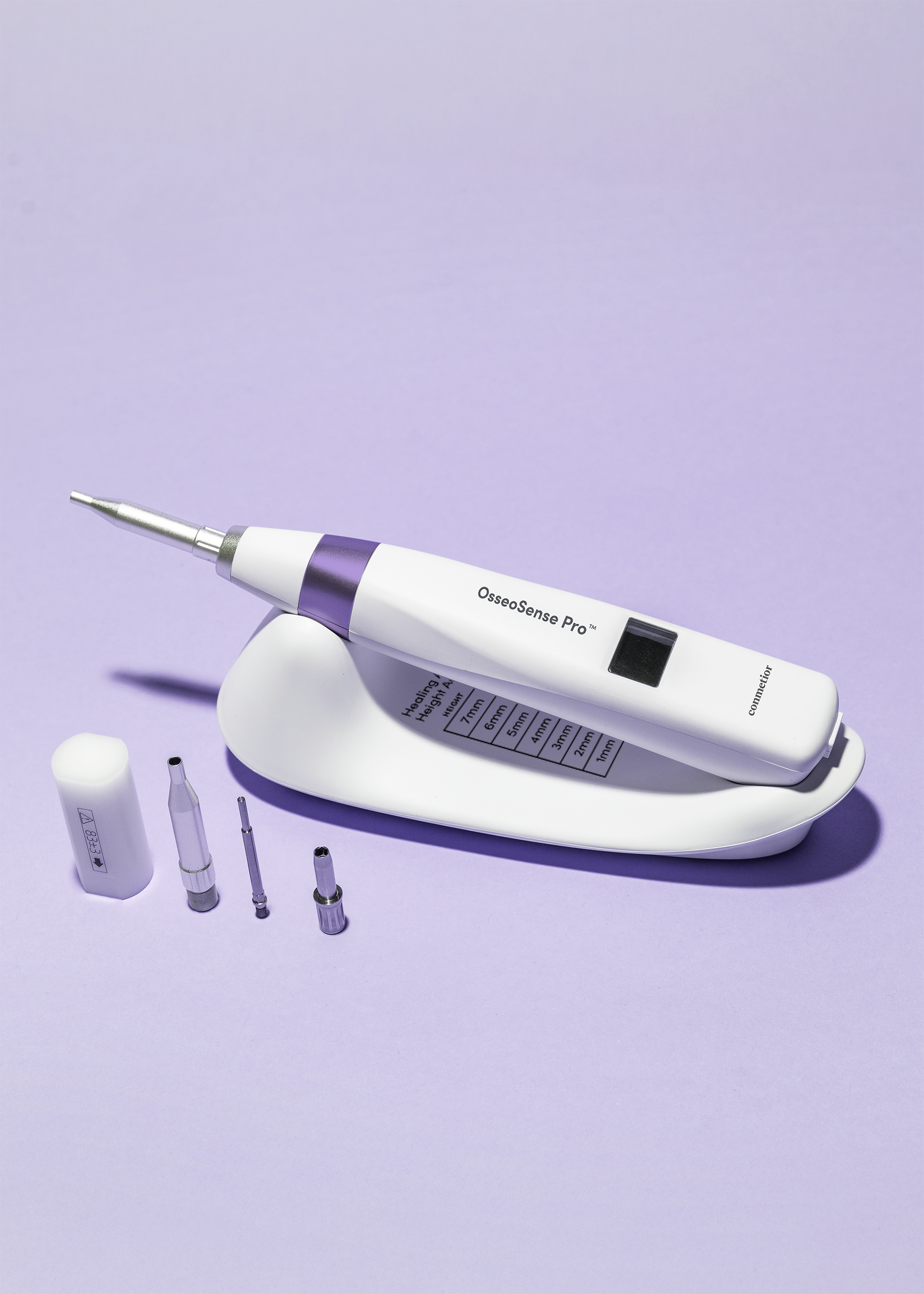
The OsseoSense Pro™ wand pairs with a charging cradle, interchangeable probes and primary guides, an IST tester, and a socket wrench — so a single reusable device covers healing abutments through final crowns, case after case. Only inexpensive per-patient sleeves are disposable; there are no costly single-use titanium pegs.
Reusable probes & guides — 200+ sterilization cycles
USB-C charge · ~4,000 measurements per charge
Hygienic single-use sleeves — no titanium pegs
Chairside in Seconds
Take the guesswork out of every prognosis
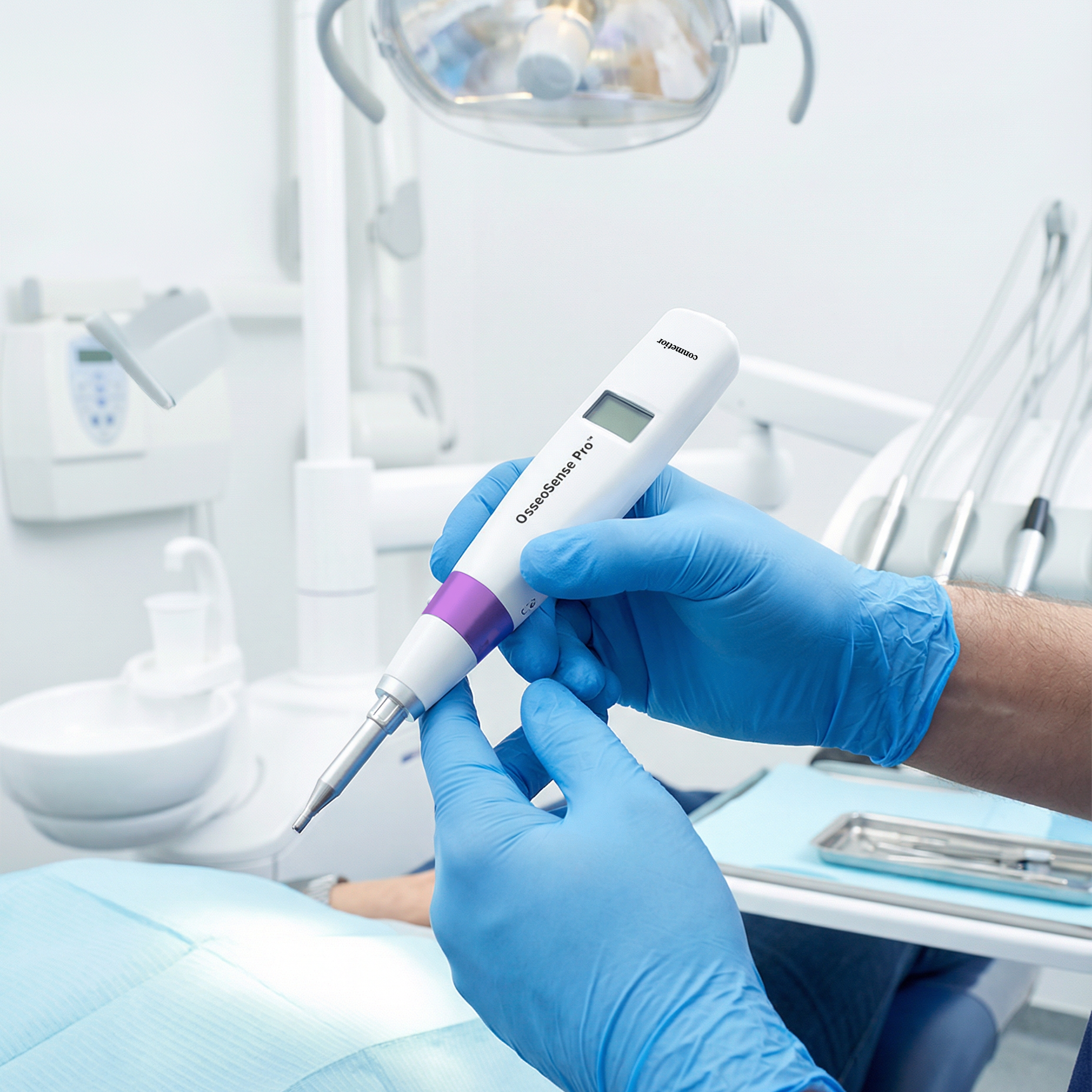
Place the probe, read the value, decide with confidence. OsseoSense Pro™ lets you evaluate an implant without removing the crown — making it easy to flag a potential failure early and to time the final restoration right.
Non-invasive assessment, crown in place
Early prognosis of potential implant failure
Better outcomes, fewer surprises
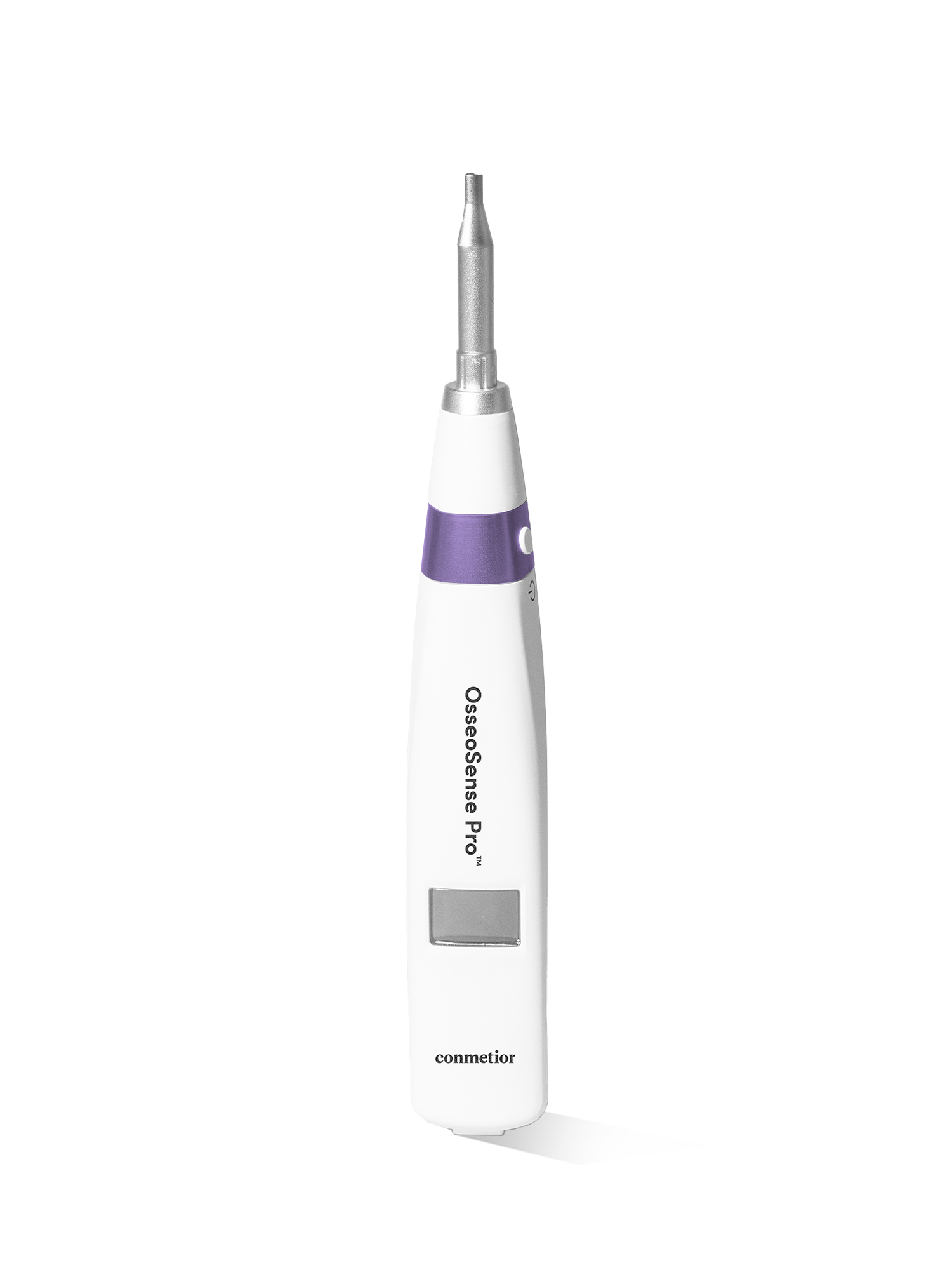
OsseoSense Pro™ is a handheld device that tells dental clinicians whether an implant is stable enough to load, and it does it in under three seconds. Instead of guessing how well an implant has integrated with the bone, you place the wand's probe against the healing abutment, abutment, or even the crown, and a gentle tapping technique returns an objective stability number on the IST scale (1–99). The reading is color-coded so it's instantly clear: red (1–59) means more healing time is needed, yellow (60–64) suggests a bridge restoration, and green (65–99) means strong stability, above 70, single-case loading is possible. A built-in safety system keeps it implant-safe, stopping after just two gentle taps if integration is unstable and only continuing when the implant reads as solid.
What makes it stand out is that it removes both cost and guesswork. Unlike peg-based systems, it needs no expensive single-use titanium pegs and doesn't require removing the crown to take a reading. It's a reusable system (probes and guides withstand 200+ sterilization cycles), charges over USB-C for roughly 4,000 measurements per charge, and works with all major implant systems, making it a versatile tool for both placing and restoring implants. It gives clinicians an objective, repeatable data point for timing final restorations with confidence and lowering the risk of implant failure.
From the Chair
Certainty, not estimation
"I get a stability number without pulling the crown. It's changed how confidently I time my final restorations."
"No more buying pegs for every system. It paid for itself faster than I expected, and the auto-stop gives me peace of mind."
"Simple, fast, and reads beautifully chairside. The IST value is exactly the objective data point I was missing."
Stop estimating. Measure it.
Add OsseoSense Pro™ to your practice and bring objective, chairside certainty to every implant case.
OsseoSense Pro™ is a handheld device that tells dental clinicians whether an implant is stable enough to load, and it does it in under three seconds. Instead of guessing how well an implant has integrated with the bone, you place the wand's probe against the healing abutment, abutment, or even the crown, and a gentle tapping technique returns an objective stability number on the IST scale (1–99). The reading is color-coded so it's instantly clear: red (1–59) means more healing time is needed, yellow (60–64) suggests a bridge restoration, and green (65–99) means strong stability, above 70, single-case loading is possible. A built-in safety system keeps it implant-safe, stopping after just two gentle taps if integration is unstable and only continuing when the implant reads as solid.
What makes it stand out is that it removes both cost and guesswork. Unlike peg-based systems, it needs no expensive single-use titanium pegs and doesn't require removing the crown to take a reading. It's a reusable system (probes and guides withstand 200+ sterilization cycles), charges over USB-C for roughly 4,000 measurements per charge, and works with all major implant systems, making it a versatile tool for both placing and restoring implants. It gives clinicians an objective, repeatable data point for timing final restorations with confidence and lowering the risk of implant failure.