
The Invisible Strain: The Biomechanical Reality of AOX & Why It Works
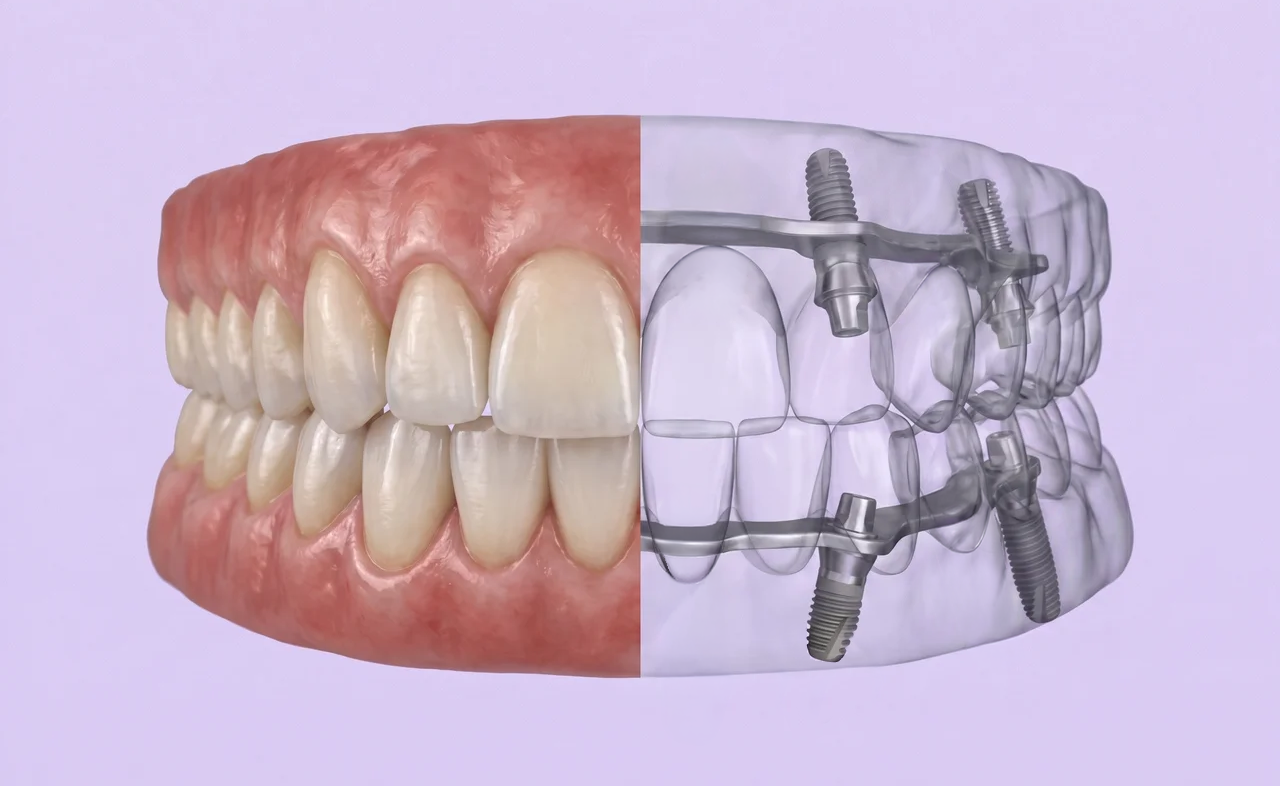
Modern All-on-X dentistry is one of the most impressive biomechanical achievements in modern dentistry.
Think about what we routinely do today:
tilted implants
immediate loading
full-arch zirconia
long-span restorations
distal cantilevers
digital workflows
multiple implants splinted together under load
And yet, despite all of these variables, AOX success rates remain remarkably high worldwide. Why? After many years chairside on AOX surgeries and restorations, I have come to believe that one of the greatest strengths of AOX is not mechanical perfection. It is biomechanical forgiveness.
Cross-Arch Stabilization Changes Everything
The moment implants become rigidly connected together through a full-arch framework, the mechanical behavior of the system changes completely. The implants no longer behave independently. Instead, the prosthesis begins functioning as a unified structure capable of distributing force across the entire arch.
This is critical.
In single implant dentistry, overload tends to remain localized. In AOX, cross-arch stabilization allows implants to share stress collectively. The framework absorbs strain. The implants protect each other. The system compensates dynamically. This is one of the main reasons tilted implants with Multi-Unit Abutments have shown such excellent long-term success clinically. The brilliance of AOX is not that it eliminates strain. The brilliance is that it redistributes strain extremely well.
The Real Digital Debate Is Not IOS vs. Photogrammetry
One of the biggest discussions in implant dentistry today is whether photogrammetry is superior to standard intraoral scanning.
I believe this question is often misunderstood.
The real issue is not: “Which technology is more popular?” The real issue is: “How does the workflow control digital error before that error becomes mechanical strain inside the final prosthesis?” That is the true conversation.
The Challenge of Full-Arch Implant Scanning
Intraoral scanners are extraordinary tools and have transformed dentistry forever. For single units, short spans, and many restorative procedures, IOS workflows are now routine and highly predictable. But AOX is different. An edentulous arch presents a very difficult scanning environment:
limited landmarks
mobile tissue
blood and saliva
repetitive anatomy
long scanning spans
multiple implant positions
Traditional IOS systems often rely on image stitching across long distances. Small discrepancies can accumulate across the arch. A few microns here. A few microns there. A small rotational discrepancy. A slight angular deviation. Suddenly, the digital file may look beautiful on the screen while still being mechanically inaccurate. That hidden discrepancy does not disappear. It becomes stored strain.
Why Photogrammetry Became So Important
Photogrammetry became popular because it approached the problem differently. Rather than stitching continuous surfaces together, photogrammetry captures the precise three-dimensional relationship between implants using specialized markers and calibrated camera systems. It is not trying to recreate the tissue. It is trying to map implant coordinates. For rigid full-arch restorations, that distinction matters tremendously. Because zirconia does not flex. Titanium does not adapt. A milled framework either fits passively or it stores tension internally.
But This Is Not a Religious Debate
That said, I do not believe the answer is simply: “Photogrammetry good, IOS bad.” That is far too simplistic. The technology is evolving rapidly. Several non-photogrammetry workflows now perform extremely well when properly understood and properly controlled.
Systems such as FI3LD and other grammetry-style workflows have shown that IOS-based systems can become highly effective by improving reference geometry, scan strategy, verification methods, and digital workflow control. Major companies such as Straumann and Nobel Biocare have also introduced advanced full-arch digital workflows because the industry recognizes that the future of implant dentistry is digital.
The real issue is no longer: “What scanner are you using?”
The real issue is: “How does your workflow verify and control distortion?”
Digital Error Eventually Becomes Mechanical Stress
This is where engineering reality begins. A full-arch zirconia prosthesis may:
seat clinically
torque correctly
look passive
function initially
while still carrying internal strain.
If implant positions are even slightly inaccurate, the prosthesis may still be forced into place during final torque. The framework may adapt. The screws may compensate. The implants may redistribute stress. Because AOX systems are so biomechanically forgiving, these hidden tensions may remain clinically silent for years.
Until one day:
screws begin loosening
zirconia chips
prosthetic components fatigue
frameworks fracture
crestal bone remodeling appears
Often, the failure did not begin at the moment something broke. It began much earlier inside the digital workflow itself.
Technology Alone Does Not Guarantee Passive Fit
This is where the conversation becomes even more important. A doctor may use one of the best photogrammetry systems in the world and still end up with a framework that is not truly passive. Why? Because implant capture accuracy is only one part of the chain. After the scan, the case still passes through:
CAD design
nesting
milling
machine calibration
tool wear
sintering
finishing
polishing
characterization
final assembly
Every one of those steps can introduce distortion. If a milling machine is not properly calibrated, dimensional accuracy can drift. If burs become worn, precision changes. If a sintering oven is not calibrated correctly, zirconia shrinkage may become inconsistent across a long-span framework. And unlike a single crown, a full-arch zirconia bridge has very little ability to hide distortion. The irony is that the original implant capture may have been excellent. The distortion happened later. This is why passive fit is not simply a scanning discussion. It is a complete manufacturing discussion.
Not All Zirconia Behaves the Same
Another oversimplification in dentistry today is the idea that all zirconia materials are essentially identical. They are not. Modern zirconias vary significantly depending on:
yttria content
grain structure
translucency formulation
fracture toughness
manufacturing quality
sintering behavior
aging resistance
The industry’s push toward higher translucency has often come with tradeoffs in mechanical toughness. Highly translucent zirconias may provide beautiful esthetics, but they may also become more brittle and less resistant to long-term fatigue under full-arch loading conditions.
This becomes extremely important in AOX:
long spans
cantilevers
bruxers
high occlusal forces
rigid implant-supported frameworks
The restorative material itself matters enormously.
The Hidden Damage Created During Finishing
Even great zirconia can become compromised if handled improperly. This is another area that receives far too little attention. Aggressive adjustment, overheating, improper polishing, sharp internal line angles, and poor finishing protocols can introduce:
surface defects
micro-fractures
stress concentration points
crack initiation zones
These microscopic defects may remain invisible clinically while significantly reducing the fatigue resistance of the restoration over time. The prosthesis may look beautiful on delivery day while already carrying structural weaknesses internally.
AOX Is Ultimately an Engineering Ecosystem
One of the biggest misconceptions in modern implant dentistry is the belief that AOX success depends on one technology alone. It does not. AOX is an engineering ecosystem. Every variable influences the others:
implant positioning
digital capture
restorative design
framework fit
milling precision
sintering calibration
zirconia quality
occlusion
cantilever management
finishing discipline
The most successful AOX clinicians and laboratories are not simply using advanced technology. They are controlling variables consistently. That is a very different thing.
The Importance of an Experienced AOX Laboratory
This is precisely why an experienced AOX laboratory matters so much. A true AOX laboratory understands that passive fit is not created by one scanner, one machine, or one software platform. It is the result of controlling hundreds of small variables repeatedly and predictably over time. Technology helps tremendously. But technology alone does not create excellence. The people behind the technology do.
Final Thoughts
The future of AOX dentistry is not about choosing sides between IOS and photogrammetry. The future is about understanding how digital discrepancies evolve into mechanical strain. Because in full-arch implant dentistry, the most dangerous problems are rarely the obvious ones. They are the invisible tensions hidden inside systems that appear clinically successful. And that is where digital dentistry ultimately becomes mechanical reality.
Get Your First Allure AOX Case for $1,600*
See firsthand how our specialized team manages digital errors before it becomes mechanical strain in your patient's smile.
Use code: ALLURE1600
*Terms and restrictions apply. Valid on initial full-arch restoration order for new accounts. Excludes certain raw material upgrades and specific implant component fees. Speak with a lab representative for full details.About the Author
Frank-Charles Pope III is an entrepreneur, visionary leader, and master craftsman in dental technology, with over four decades of expertise. Trained in Europe, Japan, and the U.S., he refined his skills under world-renowned ceramic masters before becoming Vice President of one of the largest laboratories in the world, where he helped scale operations dramatically. He is one of the founders and owners of Allure Dental Studio, FI3LD Dental Solutions, and Conmetior, among other companies, pioneering advancements in full-arch digital workflows, facial scanning, and augmented reality in dentistry. A prolific innovator and sought-after speaker, Frank-Charles continues to push the boundaries of digital dentistry and patient care.