
Accelerating Dental Implant Healing: A ClinicalPerspective on PEMF Technology and the Magdent MED
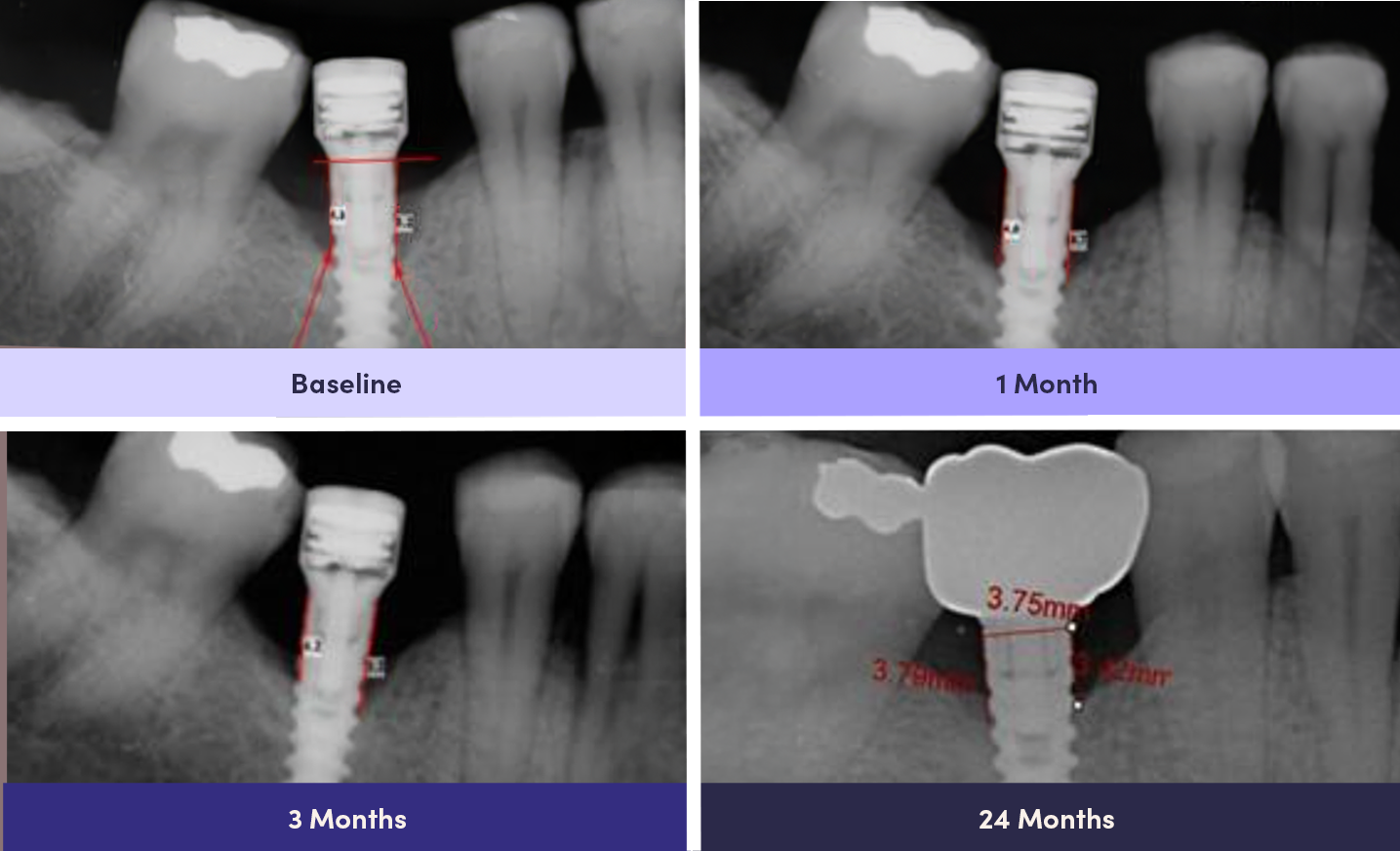
This is the 1st non-surgical clinical study demonstrating significant bone growth around implant threads, with a 24-month follow-up.
The window between implant placement and functional loading has long been treated as a passive waiting period — governed entirely by biology, beyond the clinician’s control. But with the rise of immediate loading protocols and growing demand for predictability in compromised bone, that assumption is changing. The Magdent Miniaturized Electromagnetic Device (MED) offers a compelling answer, bringing Pulsed Electromagnetic Field (PEMF) technology into the oral cavity for the first time. The MED is CE marked and currently available for sale in Europe.
The Clinical Need for Active Healing
Primary stability is achieved mechanically at placement, but it declines as the body begins remodeling. Secondary stability — the biological lock-in created by new bone formation — takes weeks to develop. Between these two phases sits the well-documented “stability dip,” a temporary drop in implant stability observed three to four weeks post-placement that represents one of the most vulnerable windows in the treatment timeline.
For immediate loading, compromised bone, or aesthetic-zone work, that vulnerability translates directly into clinical risk. Historically, the only answer was to extend healing periods or select cases more conservatively — workarounds that do not address the underlying biology.
A Proven Technology, Re-Engineered for Dentistry
PEMF is not new. It has been an FDA-approved technology for bone healing since the 1970s, used widely in orthopedic surgery to treat non-union fractures. What is new is delivering this stimulation locally and continuously at the implant site. Magdent is the first company to apply this proven technology to dental healing, miniaturizing the hardware into a healing abutment that sits directly on the implant and delivers 24-hour continuous stimulation for 30 consecutive days.
The Science of Active Healing
At the cellular level, PEMF increases the proliferation and osteogenic commitment of Mesenchymal Stem Cells — the progenitors of new bone — even in adverse inflammatory conditions. It also functions as a powerful immunomodulator: pro-inflammatory markers including IL-1β and TNF-α are suppressed while anti-inflammatory cytokines are upregulated, protecting crestal bone from the resorptive cascade that typically accompanies surgical trauma. The result is not merely faster healing but more orderly healing.
Clinical Outcomes: Reversing the Stability Dip
A randomized controlled trial demonstrated:
Reversal of early loss – MED-treated implants demonstrated a 6.8% increase in stability during the first two weeks, while controls showed a 7.6% decrease relative to baseline.
Sustained gain over 12 weeks – MED implants achieved a statistically significant 13% increase in overall stability, compared to a 2% loss in controls.
Accelerated bone formation – Preclinical morphometric analysis revealed a 56% to 69% increase in trabecular bone volume (BV/TV) in the coronal region after just two to four weeks of therapy, compared to standard healing abutments.
Together, these findings suggest the MED can accelerate osseointegration by more than threefold, reinforcing the crestal region most critical to long-term esthetic and prosthetic outcomes.
Implications for Modern Loading Protocols
For clinicians working at the edges of conventional protocols, these results matter. Reinforced stability during the most vulnerable weeks of integration makes early and immediate loading more predictable, expands the safe envelope for compromised bone cases, and provides localized biological support for complex patients — without systemic pharmacology.
Immediate Loading: The Case for a Biological Safety Net
Immediate and early loading protocols have become one of the most commercially significant developments in modern implant dentistry. Patients expect teeth the same day, and practices that deliver this reliably hold a meaningful competitive advantage. Yet the biology has not changed: primary stability is finite, the stability dip is real, and early failure in an immediately loaded case carries serious clinical and reputational consequences.
This is precisely where the MED’s biological profile becomes strategically relevant. MED-treated implants not only avoid the stability dip — they reverse it, gaining 6.8% stability in the first two weeks while controls lose 7.6%. In an immediately loaded case, that reversal is the difference between secondary stability developing ahead of primary stability decay, versus both curves moving in the wrong direction. For the dental industry more broadly: implant manufacturers investing in same-day and full-arch systems are engineering around a biological gap that hardware alone cannot close. PEMF addresses that gap directly, without modifying the implant surface or protocol. As the industry consolidates around DSO-driven, high-volume practices, a device that improves outcomes at scale with no workflow change is not a niche adjunct — it is infrastructure.
Conclusion
Active healing is no longer a concept — it is a clinical reality. As the first device to bring FDA-validated bone healing technology into the oral cavity, the Magdent MED introduces a new variable into that equation — and a new standard for what predictable integration can look like. CE marked and available for European practitioners today, it offers clinicians measurable confidence during the weeks that matter most. Magdent is actively seeking strategic partnerships and investors to join this revolution in implant care.