
Why Most Screw Failures Are System Failures
What actually breaks when something goes wrong.
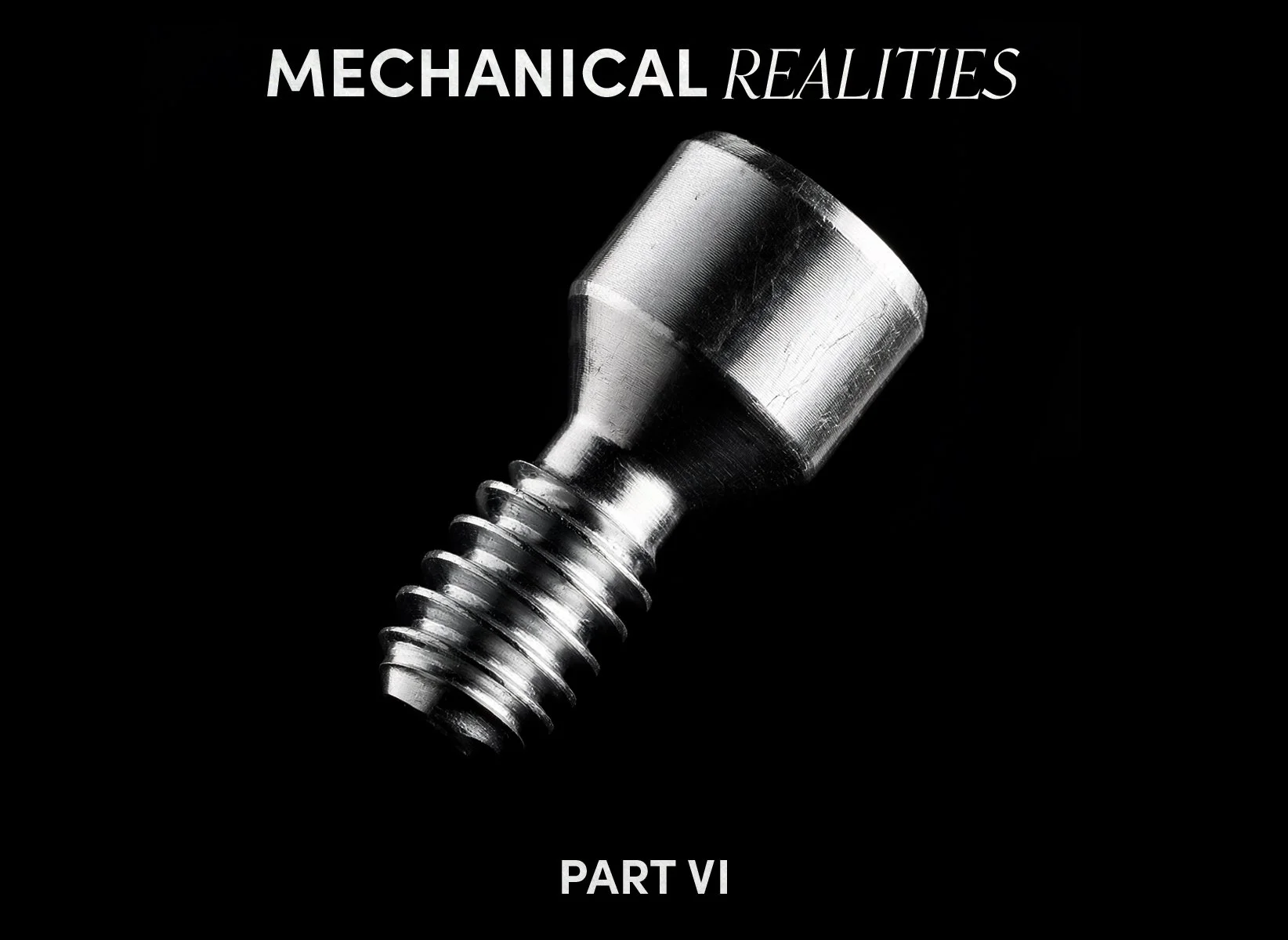
When a screw fails, attention usually turns to the moment it was tightened. The value, the tool, the hand. However, mechanically, that focus is often misplaced. Most screw failures are not the result of a single action, but the result of system behavior over time.
Failure Is Rarely a One-Time Event
In mechanical systems, catastrophic failure is usually preceded by thousands, or millions, of smaller events. Each cycle of function introduces:
Load
Unload
Micro-movement
Stress reversal
This process is known as fatigue, and it is the most common cause of screw failure across engineering disciplines. The screw does not fail because it was tightened once. It fails because it was loaded repeatedly.
Why Small Screws Are More Vulnerable
Smaller screws operate with:
Higher stress concentration
Lower margin for error
Less material to absorb cyclic load
This makes them more sensitive to:
Minor preload loss
Interface settling
Repeated micro-movement
In other words, small screws demand greater system stability, not greater force.
Why the System Matters More Than the Component
A screw exists within a system that includes:
The implant interface
The prosthetic connection
The material being retained
Functional loading patterns
If any part of that system allows movement, load is redistributed unevenly. Over time, that uneven loading accelerates fatigue, regardless of whether the original torque value was correct. The screw becomes the messenger, not the cause.
Why Numbers Can’t Prevent This
Torque values control initial conditions. They do not control:
Long-term loading
Material behavior under function
Interface changes over time
This is why failures can occur even when every number was respected. The system evolved, the value did not.
What This Means Clinically
Understanding screw failure as a system issue changes the response. Instead of asking:
“Was it over-torqued?”
The more useful questions become:
“Was preload maintained?”
“Was micromovement controlled?”
“Did the system distribute load evenly?”
This perspective improves outcomes without assigning blame, and without relying on force as a solution.
The Takeaway
Most screw failures are not tightening failures. They’re fatigue failures within a system. The screw is rarely the weakest link by accident. Its designed to reveal instability before larger components fail. Understanding this shifts the focus from the moment of tightening to the behavior of the system over time, and that is where real control lives.